
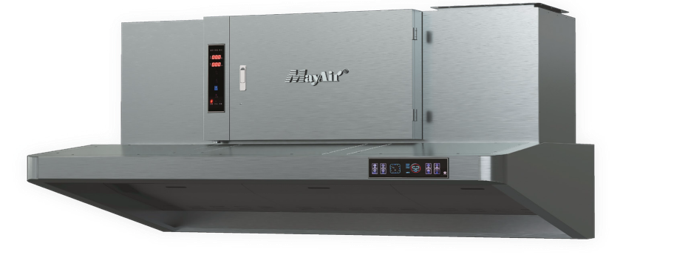
A commercial kitchen exhaust fan removes heat, steam, smoke and grease laden air from a cooking line and discharges it safely above the building. Rapid Cool supplies kitchen extract fans, kitchen ecology units and filtration to restaurants, hotels, staff canteens and central production kitchens across Dubai, Abu Dhabi and Sharjah. The specification work is not the fan on its own. It is the hood airflow, the pressure the duct run will demand, the temperature the fan has to survive, and the grease and odour treatment before discharge. Send your hood sizes and duct layout to Rapid Cool and the selection can be checked against published fan curves.
What a Commercial Kitchen Exhaust Fan Has to Do
A kitchen exhaust fan has to pull the full design airflow through a grease filter bank and a long duct run while running continuously at elevated air temperature. That combination separates it from a general ventilation fan. Office and villa extract fans move clean air against modest resistance for short periods. A kitchen fan runs for the whole trading day, handles air carrying vaporised fat, and often sits at the end of a duct route with several bends, a fire damper and a filtration unit in series.
Three consequences follow. The impeller and casing need to tolerate grease deposition and regular cleaning. The motor needs to sit out of the airstream or be rated for the air temperature it will see. The fan has to be selected at the real system resistance rather than at free delivery, because a fan chosen on airflow alone will not deliver that airflow once the filters load.
How Much Airflow Does a Commercial Kitchen Hood Need?
Hood airflow is set by the face area of the hood and the capture velocity needed to hold the cooking plume, not by the kitchen floor area. Extract systems for canopy hoods are commonly designed around a face velocity in the region of 0.25 to 0.5 metres per second across the open face, with the higher end used for heavy duty ranges, chargrills and wok cooking, and the lower end for ovens, steamers and light duty lines.
Work the figure out from the hood, then add the duct losses. A hood of 3 metres by 1.2 metres with an open face of about 2.2 square metres at 0.4 metres per second needs roughly 3,170 cubic metres per hour. Air removed has to be replaced, so the make up air strategy belongs in the same calculation. Kitchens that extract heavily without planned replacement air go negative, doors become hard to open, and the hood stops capturing because there is no air available to pull.
Why Kitchen Extract Systems Need Higher Static Pressure
Kitchen extract fans need more static pressure than general ventilation fans because the air passes through grease filters, long ducts and often an ecology unit before it leaves the building. Each element adds resistance, and that resistance rises as filters load with grease between cleaning intervals.
Select the fan at the dirty filter condition rather than the clean one. A fan picked at clean filter resistance will lose airflow steadily through the service interval, and the kitchen will be complaining about smoke at the pass long before anyone looks at the filters. Where an electrostatic precipitator or carbon stage is fitted for odour control, confirm the pressure drop of that unit at its design airflow and add it to the duct calculation. Our guide to how commercial kitchen ecology units work covers the stages in a typical treatment train.
Which Fan Types Are Used for Kitchen Extraction?
Four fan types cover almost all commercial kitchen extract duties, and the choice follows the mounting position and the pressure required.
| Fan type | Typical position | Pressure capability | Suited to |
|---|---|---|---|
| Centrifugal upblast roof fan | Roof, discharging upward clear of the slab | Medium to high | Canopy hood extract where discharge must clear the roof line |
| Centrifugal cabinet fan | Plant room or in line within the duct | Medium to high | Long duct runs, systems with filtration in series |
| In line duct fan | Within the duct route | Low to medium | Light duty kitchens, short runs, tight plant space |
| Axial fan | Wall or duct, short route | Low | General kitchen area ventilation rather than hood extract |
Upblast roof fans remain the common choice for canopy extract because the discharge is thrown clear of the roof surface and the motor sits outside the airstream. Full ranges and datasheets are on the exhaust fan suppliers in Dubai and the UAE page, and the ILG and American Coolair fan range covers the centrifugal roof and inline types used for kitchen duty.
High Temperature and Smoke Extract Duty
Kitchen extract fans handle air well above room temperature, and some projects also require the fan to survive a fire condition. Normal cooking extract runs warm. Where the system forms part of a smoke control strategy, or where a consultant specifies it, the fan has to carry a tested high temperature rating such as the F300 or F400 classes, meaning continued operation at 300 or 400 degrees Celsius for a stated period.
Treat the rating as a specification item to confirm rather than an assumption. A standard kitchen extract fan is not automatically a smoke extract fan, and retrofitting a rated unit after the duct is installed is expensive. Ask the consultant whether the extract duty is cooking only or cooking plus smoke extract before the fan is ordered.
Grease, Odour and Discharge Before the Air Leaves the Building
Air leaving a commercial kitchen carries grease aerosol and cooking odour, and in mixed use buildings both have to be dealt with before discharge. Hood mounted baffle filters take out the larger droplets. Finer aerosol passes through, which is what coats duct walls and fan impellers, and what neighbours smell.
Kitchen ecology units address this with staged treatment, typically pre filtration, electrostatic precipitation for fine aerosol and an activated carbon stage for odour. Specifying treatment at the design stage is cheaper than responding to a complaint from the floor above a year later. Rapid Cool supplies kitchen ecology units and filtration alongside the extract fan so the pressure drop of both is accounted for in one selection.
Noise Limits in Restaurants and Mixed Use Buildings
Noise becomes the deciding factor when the extract fan sits near a dining area, a residential floor or a hotel guest room. A fan that meets the airflow and pressure duty can still be rejected on sound power at the nearest sensitive receiver.
Two moves usually fix it. Select a larger fan running at lower speed for the same duty, which lowers the sound power rather than masking it. Then add attenuation in the duct where the residual level still exceeds the target. Sizing of duct sound attenuators depends on the insertion loss required per octave band, so the acoustic target needs to come from the consultant before the attenuator is selected.
How to Specify a Commercial Kitchen Exhaust Fan
Work through these six steps in order and the selection holds up at commissioning.
- Establish hood face area and capture velocity, and calculate the extract airflow per hood
- Confirm the make up air strategy so the kitchen is not driven negative
- Add duct, filter, damper and ecology unit resistance at the dirty filter condition to get total static pressure
- Confirm the air temperature at the fan, and whether a tested F300 or F400 rating is required
- Select the fan on the published curve at that airflow and pressure, and check the operating point sits in the stable region
- Check sound power at the nearest sensitive receiver and add attenuation if the target is exceeded
Send the hood schedule, duct layout and acoustic target to Rapid Cool and the selection can be returned with the fan curve, the operating point and the attenuator sizing together. Request a quotation to start that process.
FAQs
Can one exhaust fan serve two kitchen hoods?
Yes, where the hoods operate on the same schedule and the duct is balanced so each hood draws its design airflow. Hoods used at different times are better served separately, because a single fan sized for both will over extract whichever hood is working alone.
Does a kitchen exhaust fan need a variable speed drive?
A drive is useful for balancing the system at commissioning and for reducing airflow during preparation hours when the cooking line is not fully loaded. It also lets the fan compensate as grease filters load between cleans.
What happens if the kitchen extract fan is undersized on static pressure?
The fan delivers less airflow than the hood needs, the plume escapes at the hood edges, and smoke and heat spill into the kitchen. The symptom looks like a hood problem but the cause is a fan selected at the wrong operating point.
How often should kitchen extract ducts and fans be cleaned?
Cleaning frequency depends on cooking type and hours of use, with heavy duty frying and grilling lines needing the most frequent attention. Agree the interval with the facilities team and specify access panels in the duct run so cleaning is possible without dismantling the system.