

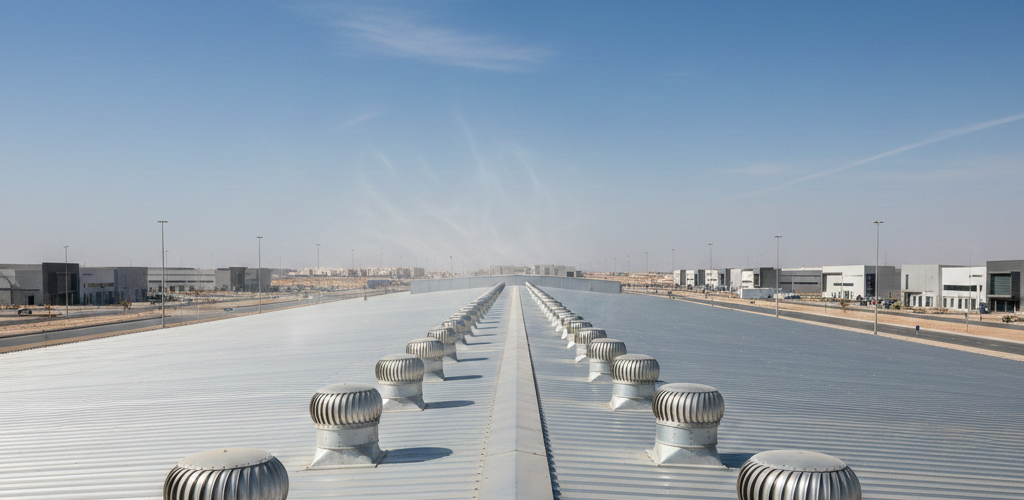
Industrial buildings in the UAE warehouses, factories, logistics hubs, workshopsface a predictable problem: heat and polluted air rise and get trapped at roof level. In summer, roof sheets and skylights can drive interior temperatures up fast, while production processes add fumes, humidity, dust, and VOCs. If that hot layer isn’t removed, you’ll see higher HVAC loads, uncomfortable working conditions, corrosion risk, and stagnant air in dead zones.
A Wind Driven Fan (also called a wind driven roof ventilator, wind turbine ventilator, or wind powered roof fan) is one of the most cost-effective ways to continuously extract that trapped heatwithout electricitywhen designed and installed correctly for UAE roofs.
What is a Wind Driven Fan?
A Wind Driven Fan is a roof-mounted, non-electric ventilator with a spinning turbine head that uses wind energy and pressure differentials to extract air from a building. As it rotates, it creates a low-pressure zone that pulls hot, stale air up through the throat and discharges it above the roofline. The exhausted air is replaced by fresh air entering through louvers, doors, or designed inletsforming a simple, reliable industrial roof ventilation loop.
Unlike powered fans, the core advantage is zero electrical consumption and the ability to ventilate continuously when wind and buoyancy (“stack effect”) are present.
How Does a Wind Driven Roof Ventilator Work?
A wind driven roof ventilator works through a combination of aerodynamics (wind-driven rotation) and thermal buoyancy.
The engineering principle (in practical terms)
- Wind hits the turbine vanes and causes the head to spin.
- The spinning vanes produce centrifugal action, creating a low-pressure region inside the turbine head that draws air upward from the building.
- As warm air is extracted, it is continuously replaced by incoming outside air (make-up air), sustaining airflow.
What keeps extraction going in light wind?
Many turbine ventilators continue rotating briefly due to a flywheel effect (stored rotational energy), helping maintain airflow even when the breeze drops.
Why roof mounting matters in UAE industrial buildings
Hot air accumulates near the roof apex. Wind driven fans placed correctly at the highest practical point of the roof help remove the hottest air layer firstoften the layer that drives discomfort and higher cooling demand.
Quick featured-snippet summary: How it works
A wind driven roof ventilator extracts hot air by using wind to spin a turbine head, creating low pressure that pulls air up through the roof opening; the exhausted air is replaced by fresh make-up air entering the building.
Key Benefits of Wind Driven Fans in UAE Climate
For Natural ventilation systems UAE applications, wind driven fans are popular because they match local operational priorities: lower energy cost, robust equipment, and low maintenance.
1) Zero electricity for exhaust (lower OPEX)
A wind driven fan operates on wind energy, meaning no wiring, no fan motors, and no electrical consumption for the exhaust function.
2) Continuous removal of roof heat pockets
In UAE warehouses, the hottest air stays high. Roof extraction helps reduce the trapped heat layerespecially when paired with:
- wall louvers
- ridge-level placement
- planned make-up air routes
3) Better comfort and productivity in working zones
Removing heat and stale air improves perceived comfort, especially in high-occupancy or high-activity spaces such as logistics and packaging areas.
4) Effective for fumes, humidity, and general air refresh
Wind-driven turbine ventilators are used to exhaust hot air, fumes, and humidity, and create a negative pressure zone that encourages fresh air intake.
5) Minimal maintenance compared to powered systems
With fewer electrical components, maintenance is mainly mechanical inspection (bearings, fasteners, flashing integrity).
Applications in Industrial & Commercial Buildings
A properly designed Turbo ventilator UAE package can support many facility types. Typical UAE use cases include:
Industrial facilities
- fabrication plants
- assembly workshops
- light manufacturing
- process areas generating heat and humidity
Warehouses & logistics
- racked storage warehouses
- distribution centers
- cold-chain “non-chilled” staging zones (to reduce heat accumulation around docks)
Commercial and utility buildings
- workshops and service centers
- indoor parking garages (typically as part of a broader ventilation strategy)
- farm/agri facilities and covered structures (where power availability is limited)
Wind-driven turbines are commonly positioned as a natural exhaust option for industrial plants, warehouses, and storage facilities.
Wind Driven Fan vs Electric Exhaust Fan (Include comparison table)
Both options can workif selected correctly. The right answer depends on heat load, required air changes, duct resistance, contaminant type, and whether you need guaranteed airflow independent of weather.
Comparison Table: Wind Driven Fan vs Electric Exhaust Fan
| Feature | Wind Driven Fan (Wind Powered Roof Fan / Wind turbine ventilator) | Electric Exhaust Fan |
| Energy consumption | No electricity for airflow generation | Continuous electrical cost (motor power) |
| Airflow control | Variable (depends on wind + stack effect) | Controllable, consistent airflow |
| Best for | Roof heat extraction, general ventilation, low-to-moderate resistance paths | High resistance systems, ducted exhaust, targeted extraction |
| Performance in still air | Reduced (relies more on buoyancy) | Unaffected by wind |
| Installation | Roof cut-out + flashing + base + turbine | Electrical wiring + fan + safety isolator; often ducting |
| Maintenance | Mechanical inspection (bearings/fasteners/flashing) | Motor, belts (if any), electrical components, controls |
| Noise | Typically low mechanical sound (site dependent) | Can be higher depending on fan type and speed |
| Suitability for hazardous exhaust | Not typically for controlled hazardous extraction without proper engineering | Possible with correctly rated fans and compliance design |
Practical note for facility engineers:
If your exhaust path includes filters, long duct runs, or needs guaranteed extraction rates (e.g., certain fume sources), electric fans are often necessary. If your goal is roof heat and stale air relief at low running cost, a wind driven roof ventilator is often the simplest solution.
Is a Wind Driven Fan Suitable for UAE Weather Conditions?
In most industrial zones across the UAE (Dubai, Abu Dhabi, Sharjah, Ajman, Ras Al Khaimah), wind-driven roof ventilators can be a strong fitbut suitability is site-specific.
When it’s a good fit in the UAE
- You have heat buildup at roof level (common in metal-roof warehouses).
- Your building can provide adequate make-up air (louvers / wall inlets / controlled openings).
- You want a low-OPEX ventilation layer to reduce reliance on mechanical cooling.
- Your exhaust path is relatively low resistance (no long ducts).
Engineering checks Rapid Cool recommends before specifying
- Roof type & waterproofing details (flashing and curb design are non-negotiable)
- Corrosion environment (coastal zones, chemical exposure; choose suitable materials)
- Air path planning (where fresh air enters; avoid short-circuiting)
- Number and sizing based on building volume, heat sources, and layout (racks/mezzanines)
- Integration with powered systems (if you have HVLS fans, evaporative cooling, or mechanical exhaust)
Quick featured-snippet summary: UAE suitability
Wind driven fans can suit UAE warehouses well for roof heat extraction and general ventilation, provided the roof installation is watertight, corrosion-resistant materials are used, and make-up air pathways are planned to support continuous airflow.
Frequently Asked Questions (FAQ)
1) What is a wind driven roof ventilator used for in industrial buildings?
A wind driven roof ventilator is used to remove hot, stale air, fumes, humidity, and trapped roof heat by creating a low-pressure zone as the turbine spins, drawing air up and out through the roof.
2) Do wind driven fans work when there is no wind in the UAE?
They work best with wind, but even with low wind they may still extract air due to temperature difference (stack effect). Hot air naturally rises toward the roof and exits more easily through a roof outlet. Performance will be lower in completely still conditions, so design should consider realistic site wind and heat loads.
3) How many turbo ventilators does a warehouse in Dubai typically need?
It depends on:
- warehouse volume and ceiling height
- heat gain from roof and process loads
- required air changes
- inlet area for make-up air
A professional survey is recommended to avoid under-sizing (ineffective) or over-installation (unnecessary roof penetrations).
[Internal Link: Ventilation Design & Calculation]
4) Are wind turbine ventilators noisy?
They are generally quiet, but noise depends on turbine quality, bearing condition, installation alignment, and wind speed. Preventive inspection and correct mounting reduce vibration and mechanical noise.
5) Can wind powered roof fans reduce HVAC load in UAE facilities?
Yeswhen they remove the roof heat reservoir and improve air turnover, they can reduce the temperature stratification that forces HVAC to work harder. They are often used as part of a broader industrial roof ventilation strategy rather than a standalone replacement for cooling.
Conclusion: Specify Wind Driven Fans CorrectlyThen They Pay Back
A Wind Driven Fan is not a “generic roof spinner.” In UAE industrial conditions, it’s a practical engineering tool for natural exhaust, helping address roof-level heat buildup and air stagnation with near-zero operating cost. The difference between great results and disappointment comes down to proper sizing, placement, waterproof installation, and make-up air planning.
If you’re evaluating a wind driven roof ventilator, planning industrial roof ventilation, or comparing Turbo ventilator UAE options for a warehouse or factory, Rapid Cool can help you specify and implement a solution that performs reliably in real UAE operating conditions.
Contact Rapid Cool for a professional site assessment and ventilation consultation in Dubai and across the UAEand get a clear recommendation on turbine ventilators, inlet strategy, and integration with existing mechanical systems.
