
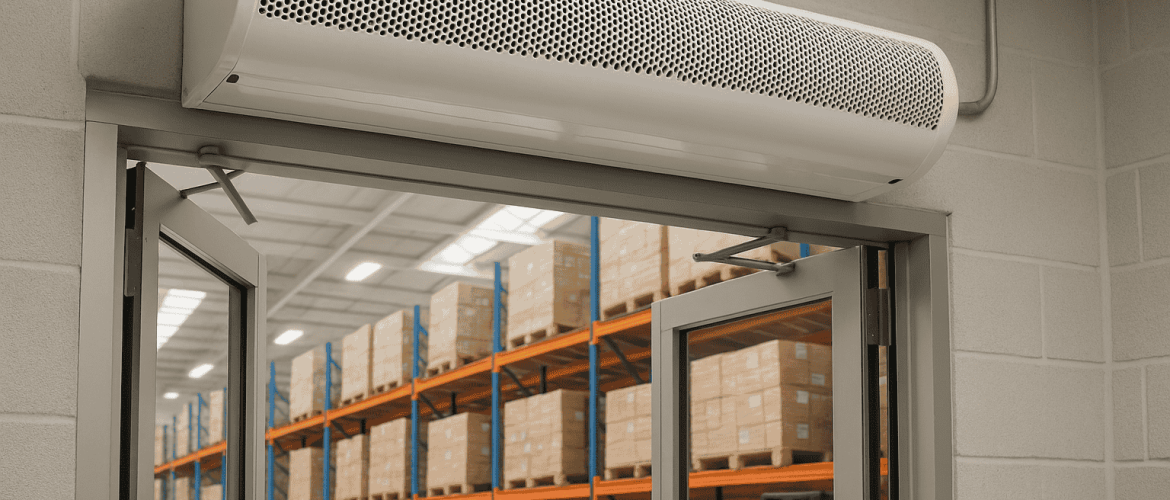
An air curtain sensor is the control device that switches an air curtain on when a door opens and off, or down to a lower speed, when it closes. Most systems use one of three signals: a door contact switch fitted to the door frame, a motion sensor that detects people or vehicles approaching, or a command from the building management system (BMS). In UAE buildings, where the air curtain protects an air-conditioned space from outdoor air above 45 degrees Celsius, the sensor decides whether the unit runs only when it is needed or wastes energy and adds noise for hours at a time.
This guide explains how each sensor type works, where it fits, and what to confirm with your supplier before ordering.
What Does an Air Curtain Sensor Do?
An air curtain sensor links the air curtain to the state of the doorway so the airstream is running at the moment the door opens. An air curtain only does useful work while the door is open. With the door shut, the fan is moving conditioned air for nothing, and on heated models the heater is burning electricity for nothing too.
Automatic control solves three practical problems on commercial entrances:
- Energy waste – the fan and any heater coil run only during door-open periods instead of the full trading day
- Staff reliance – nobody has to remember to switch the unit on at opening time or off at night
- Noise – front-of-house areas in retail, hospitality and healthcare stay quieter when the unit is idle
Every air curtain series supplied by Rapid Cool from Olefini air curtains can be interlocked with the door for automatic operation, and most series offer BMS integration on request.
What Types of Air Curtain Sensors Are Available?
Air curtain sensors fall into four groups, defined by what they detect and where they are mounted.
| Sensor type | What it detects | Typical mounting | Best suited to |
|---|---|---|---|
| Door contact (magnetic reed) switch | Door leaf leaving the frame | Door head or frame | Hinged and automatic sliding doors at shops, offices, clinics |
| Limit switch | Shutter or roller door reaching an open position | Door guide rail or shutter box | Loading docks, warehouses, cold store doors |
| Motion sensor (PIR or microwave) | People or vehicles approaching the opening | Above or beside the doorway | Doorless openings and high-traffic entrances |
| BMS signal | Command from the building management system | Control panel via dry contact | Malls, hotels, hospitals, airports with central control |
Door Contact Switches
A door contact switch is the most common and most reliable air curtain sensor. A magnet on the door and a reed switch on the frame complete or break a circuit as the door moves. When the contact opens, the air curtain starts at full speed. When the door closes, the unit stops or drops to low speed after a short run-on delay. Because the switch reacts to the door itself, it does not trigger on passers-by and it does not need line-of-sight adjustment.
Limit Switches for Industrial Doors
Limit switches suit roller shutters, sectional doors and fast-acting PVC doors at warehouses and loading bays. The switch is tripped by the door reaching a set position, which makes it robust in dusty environments where optical sensors struggle. It is a natural match for industrial air curtains mounted over loading doors, such as the Olefini Industrial series with a throw of 5.5 to 6.0 metres.
Motion Sensors
Motion sensors detect movement in a zone in front of the opening. Passive infrared (PIR) sensors respond to body heat, while microwave or radar sensors respond to moving objects of any temperature. They are useful where there is no door to monitor, but they need careful aiming. A sensor that sees the pavement or a busy mall corridor will run the air curtain far more than the door traffic requires.
BMS Integration
BMS integration lets the air curtain take start, stop and speed commands from the building’s central control system, usually through a volt-free dry contact. Large sites use this to tie air curtain operation to opening hours, fire alarm shutdown, and door status signals already wired into the BMS. Olefini Designer, Stainless Steel, Recessed, Commercial and Industrial series are all available with BMS integration on request.
How Does an Automatic Air Curtain Respond When the Door Opens?
An automatic air curtain follows a simple control sequence each time the doorway is used:
- Door opens or movement is detected – the sensor sends a signal to the air curtain controller
- Fan ramps to high speed – the discharge reaches its full throw toward the floor to seal the opening
- Door stays open – the unit holds high speed for as long as the signal remains active
- Door closes – a run-on timer keeps the airstream going for a short period to clear air that entered during the closing movement
- Standby – the fan stops or falls back to a low idle speed, depending on how the controller is set
The run-on time and idle speed are set during commissioning. Entrances with frequent short openings, such as a supermarket front door, usually work better with a low idle speed than with full stop-start cycles.
Why Does Sensor Control Matter for UAE Entrances?
Sensor control matters in the UAE because the air curtain is working against a large temperature and humidity difference for most of the year. The airstream has to reach the floor with enough velocity to hold back hot, humid, and often dusty outdoor air. If the unit is idle when the door swings open, that air enters the conditioned space before the fan gets up to speed.
Velocity at the floor is the measure that counts. ASHRAE Standard 90.1-2019 accepts air curtains as an alternative to entrance vestibules when the unit delivers at least 400 feet per minute (about 2 metres per second) at the floor and is tested to ANSI/AMCA Standard 220 (per ASHRAE 90.1 guidance summarised by air curtain manufacturer Berner). A sensor that starts the unit early and holds it on through the full door cycle is what lets an air curtain deliver that velocity at the moment it is needed.
For a wider view of where air curtains pay back in commercial and industrial buildings, see our guide on what air curtains are used for.
How to Choose the Right Air Curtain Sensor: 5 Checks
Work through these five checks before you specify the control:
- Door type – hinged and sliding doors suit a door contact switch, roller shutters and sectional doors suit a limit switch, and open doorways need a motion sensor
- Traffic pattern – frequent short openings favour a low idle speed with a run-on timer, while occasional openings favour full stop-start operation
- Control architecture – confirm whether the site BMS needs to start, stop or monitor the air curtain, and request a dry contact interface if it does
- Heater option – on units with an electric heater or hot-water coil, confirm the heater is interlocked so it never runs without airflow
- Mounting and wiring – confirm cable routes from the door head to the unit, especially for recessed units concealed in a false ceiling
The installation position of the air curtain itself matters as much as the sensor. Our buyer’s guide on choosing the right air curtain for your doorway covers door width, air velocity, and mounting height.
Which Olefini Air Curtain Series Supports Automatic Control?
All six Olefini series supplied by Rapid Cool can be interlocked with the door for automatic operation. The table below summarises the options listed on the Olefini product range.
| Olefini series | Door interlock | BMS integration | Maximum throw | Heating options |
|---|---|---|---|---|
| Designer (C series, Anemoessa) | Yes | On request | 3.5 – 4.0 m | Electric heater |
| Stainless Steel | Yes | On request | 2.5 – 3.0 m | Electric heater |
| Recessed / Concealed | Yes | On request | 3.5 – 4.0 m | Electric heater or hot-water coil |
| Commercial & General Purpose | Yes | On request | 2.5 – 4.0 m | Electric, hot-water or CHW coil |
| Industrial | Yes | On request | 5.5 – 6.0 m | Electric, hot-water or CHW coil |
| Plastic | Yes | Not listed | 2.5 – 3.0 m | Electric heater |
Full specifications, sizes, and technical datasheets for each series are on the Olefini air curtain suppliers in UAE page.
Why Rapid Cool Group for Air Curtains and Controls
Rapid Cool Group, an HVAC trading group established in Dubai in 1995 with a branch in Sharjah, supplies Olefini air curtains across the UAE and the Gulf. Olefini S.A. was established in Greece in 1977, distributes to more than 30 countries, and has been supplied in over 200 major projects in the UAE. Reference projects include Dubai International Airport Expansion, Dubai World Central Cargo Terminal, Madinat Jumeirah, City Walk Phase I and II, St. Regis Beach Resort Abu Dhabi, and The Presidential Palace in Abu Dhabi.
For consultants and contractors, the practical benefit is a single supplier for the air curtain, its door interlock, and its BMS interface, selected together for the opening. Contact Rapid Cool with your door sizes and door types for a selection.
FAQs
Can an existing air curtain be fitted with a door sensor?
In most cases, yes. A door contact switch or limit switch can be wired to the air curtain controller, provided the unit’s control board accepts an external start signal. Confirm the model and controller before ordering the sensor.
Is a door switch better than a motion sensor for an air curtain?
A door switch is more reliable where there is a physical door, because it responds only to the door opening. A motion sensor is the better choice for doorless openings, but it needs careful aiming to avoid false triggers.
Should an air curtain stop completely when the door closes?
Not always. Entrances with frequent short openings often perform better with a low idle speed and a run-on timer, because the fan does not have to ramp up from standstill each time.
Can air curtains be controlled by a building management system?
Yes. Olefini Designer, Stainless Steel, Recessed, Commercial and Industrial series offer BMS integration on request, typically through a dry contact for start, stop and status.