
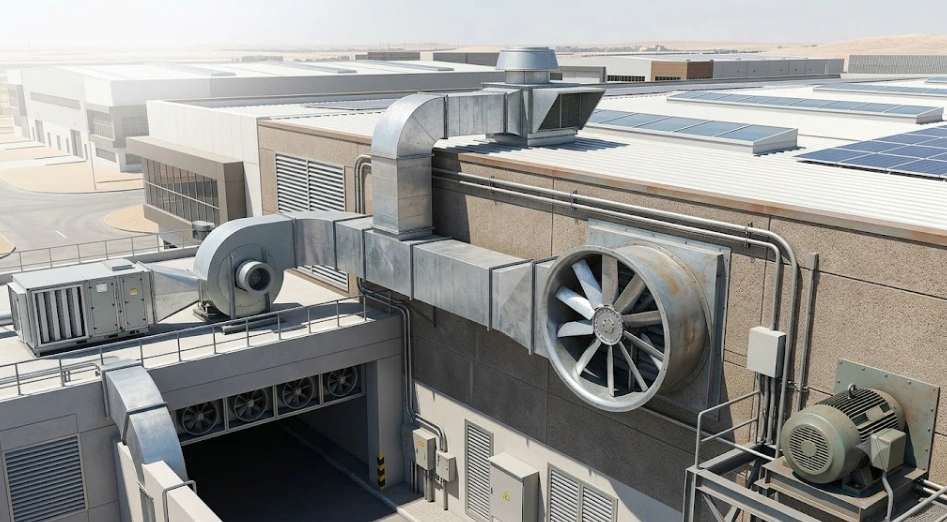
An industrial exhaust fan removes heat, fumes, dust, smoke, or stale air from a building or process by pulling air out of the space and discharging it outside. In the UAE, these fans run in some of the hardest conditions in the industry: ambient temperatures above 45 degrees Celsius, corrosive coastal air, and duty cycles that demand fire-rated performance during emergencies. Choosing the wrong fan type is one of the most expensive mistakes in mechanical services, because the fan must be selected against airflow, static pressure, mounting, and safety certification all at once.
This guide explains the main fan types used across UAE projects, how to match a fan to the application, and what a specifying buyer should verify before ordering.
What Types of Industrial Exhaust Fans Are Used in UAE Buildings?
Industrial exhaust fans fall into six practical categories, defined by how they move air and where they mount. Rapid Cool Group, an HVAC trading group established in Dubai in 1995 with a branch in Sharjah, supplies each of these categories through its trading division as exclusive distributor of major European and USA brands, including the Sodeca range of industrial fans.
- Axial and propeller fans – direct or belt driven, inline or wall mounted, for exhaust and supply applications, with bifurcated versions for high temperature duties
- Centrifugal fans – commercial and industrial ranges, direct or belt driven, with forward or backward curved impellers, in inline and utility configurations, with special construction in PVC and SS316 for corrosive duty
- Roof curb mounted fans – axial and centrifugal ranges in down-blast and up-blast configurations, with motor-out-of-airstream options and special chimney and solar fans
- Smoke extract fans – axial and centrifugal ranges rated 400 degrees Celsius for 2 hours and approved by Dubai Civil Defence
- ATEX certified explosion proof fans – for hazardous areas in Zone 1, Zone 21, Zone 2 and Zone 22, up to the highest motor classification EExd T6
- Jet fans – impulse and induction types for basement car park ventilation, with factory design support and in-house CFD analysis
Axial or Centrifugal: Which Fan Does Your Application Need?
Axial fans move high volumes of air at low pressure, while centrifugal fans move air against higher static pressure. That single distinction drives most fan selections in UAE projects (per fan selection guidance from Cincinnati Fan and Hartzell Air Movement).
The decision comes down to the resistance of the system the fan must overcome:
- Low resistance, high volume – open wall openings, short duct runs, and general warehouse or generator room exhaust suit axial fans
- High resistance, controlled duty – long duct networks, kitchen hoods with grease filters, and filter banks create static pressure that only a centrifugal impeller handles efficiently
As a rule of thumb, the higher the airflow, the greater the noise generated, which is why fan selection and noise control (covered in our sound attenuator guide) must be planned together.
Factor | Axial fan | Centrifugal fan |
Airflow vs pressure | High volume, low pressure | Lower volume, higher static pressure |
Typical mounting | Inline, wall, bifurcated | Inline, utility, roof curb |
Impeller options | Propeller, direct or belt drive | Forward or backward curved |
Special builds | High temperature bifurcated | PVC and SS316 for corrosive air |
Best suited to | General exhaust, supply air | Ducted systems, kitchens, process exhaust |
Smoke Extract and Car Park Fans: What Dubai Civil Defence Requires
Smoke extract fans are not ordinary exhaust fans: they must keep running while the building around them is on fire. The common fire rating for car park smoke extraction fans is F400, meaning 400 degrees Celsius for 120 minutes, verified by independent testing to EN 12101-3 (per car park fire safety design guidance from Venturka). Jet fans for basement ventilation use impulse or induction designs to move air along the car park and toward extract points, and they must be backed by real airflow design rather than guesswork.
Rapid Cool supplies smoke extract and jet fan ranges that carry a 400 degrees Celsius / 2 hours rating approved by local Civil Defence, with basement ventilation designs prepared by factory engineers and in-house CFD analysis for jet fan layouts. For hazardous industrial sites, the Sodeca range adds ATEX certification for Zone 1, Zone 21, Zone 2 and Zone 22 environments, available with the highest motor classification of EExd T6, serving the marine, chemical, mining, and energy plant industries.
How to Select an Industrial Exhaust Fan: 5 Checks Before You Order
Work through these five checks in order before approving any fan purchase:
- Required airflow – calculate the exhaust volume in cubic metres per hour from the room size, air change rate, or process heat load
- System static pressure – total the resistance of ducts, filters, dampers, and louvres the fan must overcome, then choose axial for low pressure or centrifugal for high pressure duty
- Mounting and space – confirm whether the fan mounts in a wall, inline in a duct, or on a roof curb, since each configuration is a different product
- Safety certification – for smoke extract and hazardous areas, verify the fire rating and ATEX zone classification against the project specification
- Drive and construction – choose direct or belt drive for maintenance strategy, and request special PVC or SS316 construction where exhaust air is corrosive
Who Rapid Cool Group Supplies in the UAE
Rapid Cool Group has been part of several major projects across the UAE and the Gulf, and its supplied fan ranges appear in landmark references including Al Habtoor City, Dubai Autism Center, ONE JLT, the Apple Store at Mall of the Emirates, Al Maktoum Hospital, Burjeel Hospital Abu Dhabi, Prime Hospital, over 25 DEWA substations, over 10 Carrefour stores, City of Lights on Reem Island, and Standard Chartered Tower. The group’s trading division distributes the Sodeca brand, which has manufactured industrial fans, ventilation systems, and smoke extraction systems since 1983 and has been present in the UAE market for over two decades.
For architects, contractors, and consultants, this matters in one practical way: the fan types above are available locally with Civil Defence approvals already in place, removing the lead-time and approval risk of importing unvetted equipment.
FAQs
What is the difference between an axial fan and a bifurcated fan?
A bifurcated fan is an axial fan whose motor sits outside the airstream in a split casing, which suits high temperature and contaminated air applications where the motor must be protected.
Do smoke extract fans in Dubai need Civil Defence approval?
Yes. Smoke extract fans must carry a certified fire rating, and the ranges supplied by Rapid Cool are rated 400 degrees Celsius for 2 hours with local Civil Defence approval.
Can exhaust fans be certified for explosive atmospheres?
Yes. ATEX certified explosion proof fans are available for Zone 1, Zone 21, Zone 2 and Zone 22 areas, up to motor classification EExd T6, in axial and centrifugal configurations.
What construction is used for corrosive exhaust air?
Centrifugal fans with special PVC and SS316 construction are available for corrosive process exhaust in chemical and marine applications.