
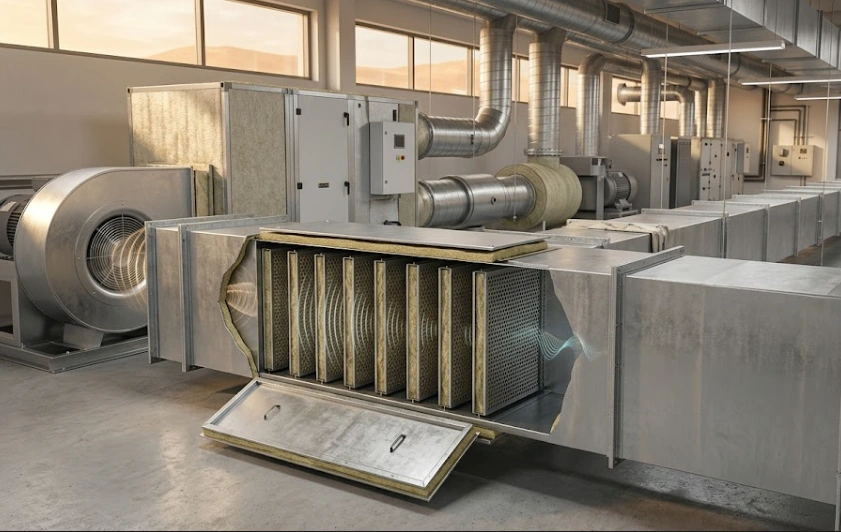
A sound attenuator is a duct-mounted device that reduces noise travelling through an HVAC system: air passes through a silenced casing while acoustic splitters absorb the sound energy of fans and airflow, delivering an insertion loss typically between 15 and 50 decibels depending on design and frequency. It is the standard answer wherever a powerful fan and a quiet space share the same ductwork, which in the UAE means almost every hospital, hotel, office tower, and data centre.
Fan selection and noise control are two halves of the same decision. This guide explains what an attenuator actually does, how insertion loss is measured, and how to select one without choking the airflow you just paid for.
Where Does HVAC Noise Actually Come From?
HVAC noise reaches occupied spaces through three distinct paths, and an attenuator only fixes one of them:
- Duct-borne noise – sound from the fan and airflow travelling through the duct to the diffuser, the path a sound attenuator treats directly
- Breakout noise – sound radiating through the duct wall itself into rooms the duct passes; a conventional 0.71 mm sheet metal duct achieves only a modest average sound reduction index, per health facility building services noise guidance (iHEEM)
- Structure-borne noise and vibration – fan vibration transmitted through mounts and building structure, treated with isolation rather than silencers
Natural ductwork does provide some attenuation, but it is small: unlined rectangular ductwork delivers roughly 0.1 to 0.6 dB per metre depending on size and frequency (per acoustic design references on NC criteria). Against a fan noise source measured in high decibels, that is rarely enough to hit the target background noise level of the room.
What Is Insertion Loss and How Is It Measured?
Insertion loss is the reduction in sound power level at the receiver after the silencer is installed in the system, expressed in decibels (per the standard definition used in acoustics references and Egypt Air’s attenuator documentation). It is measured across octave band frequencies, not as a single number, because an attenuator performs very differently at low frequencies, where fan rumble lives, than at high frequencies.
Two practical limits matter to specifiers:
- The highest achievable insertion loss of a standard attenuator is capped around 40 dB, because sound transmits through the attenuator’s own sheet metal casing; beyond that, the casing itself must be upgraded (per technical literature on sound attenuator casing transmission)
- Commercially available splitter silencers in rectangular and circular form offer insertion loss up to 50 dB with minimal pressure drop, depending on length and splitter configuration (per manufacturer data from IBET)
Performance data should be validated against laboratory testing to ISO 7235, the standard test method for silencer measurement (per published insertion loss validation research).
Rectangular Splitter vs Circular Attenuators: Which One Fits Your Duct?
The attenuator shape follows the duct shape, and the choice changes both the acoustic performance and the pressure drop:
- Rectangular splitter attenuators – internal acoustic splitters parallel to the airflow, used in rectangular ductwork; splitter count, spacing, and length tune the insertion loss, making them the standard choice for large AHU connections in plant rooms
- Circular attenuators – concentric annular linings for round ducts, compact and self-supporting, common on inline fan connections and exposed services
- Custom and special constructions – thicker casings for high insertion loss targets, and combinations with acoustic lagging to control casing breakout at the same time
| Attribute | Rectangular splitter attenuator | Circular attenuator |
| Typical position | Plant room AHU and main duct connections | Inline fan connections, exposed round ducts |
| Tuning method | Splitter count, spacing, module length | Annular lining thickness, module length |
| Strength | High insertion loss, octave-band tunable | Compact, low pressure drop, easy install |
| Limitation | Larger casing, needs plenum space | Lower maximum insertion loss per module |
How to Select a Sound Attenuator Without Killing Your Airflow
An attenuator trades pressure for silence: every decibel of absorption adds resistance the fan must overcome. The selection sequence that protects both targets:
- Define the room target – establish the required background noise level in NC or NR terms for each occupied space, since hospitals, hotels, offices, and data centres carry very different limits (per NC and NR criteria references from Engineering ToolBox and Svantek)
- Get the octave band data – obtain the fan’s sound power spectrum and the manufacturer’s attenuator data band by band; never select on a single averaged dB value (per silencer selection guidance)
- Calculate required insertion loss – the difference between the fan spectrum and the room target, duct by duct
- Check the pressure drop budget – compare the attenuator’s pressure loss against the fan’s spare static pressure capacity; if the fan was selected with no margin, the attenuator will starve the system
- Verify the casing – for insertion losses above about 40 dB, specify upgraded casing construction so sound does not simply pass through the attenuator body
Why Rapid Cool Group for Attenuators and Fans Together
Sound attenuators are part of the standard Rapid Cool product range alongside ventilation fans, closed control units, ecology units, cooling tower components, air curtains, and acoustic lagging, supplied by a group established in Dubai in 1995 with a branch in Sharjah and serving major projects across the UAE and Gulf. Because the same source supplies the fans and the attenuation, the fan sound spectrum and the attenuator insertion loss can be matched from the start, which is exactly what the octave band selection method requires.
FAQs
What is a sound attenuator in an HVAC system?
It is a duct silencer: a cased section of duct with internal acoustic splitters that absorb fan and airflow noise, delivering an insertion loss typically in the range of 15 to 50 decibels while air passes through.
How many decibels of reduction can an attenuator achieve?
Standard attenuator modules reach up to around 40 dB before sound transmits through the casing itself; commercial splitter silencers are available with insertion loss up to 50 dB, and higher targets require upgraded casing construction.
Does a sound attenuator reduce airflow?
Any silencer adds pressure drop. The fix is not to skip the attenuator but to select it against the fan’s spare static pressure, checking octave band performance rather than a single dB figure.
Where should attenuators be installed?
As close as practical to the noise source, typically on AHU supply and exhaust connections, with duct breakout controlled separately through lagging and casing selection.