
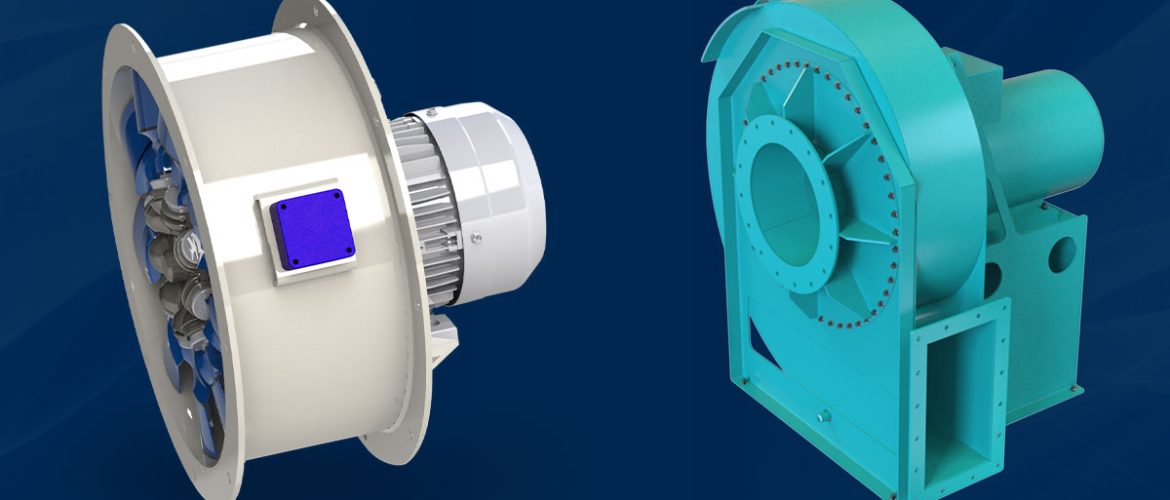
A centrifugal fan moves air by drawing it into the centre of a rotating impeller and throwing it outward at 90 degrees into a scroll-shaped or box housing, where the air leaves at a higher pressure. That ability to build static pressure is what separates centrifugal fans from axial fans, and it is why centrifugal fans sit behind kitchen hoods, filter banks, long duct runs, and smoke extract systems across UAE buildings.
This guide explains the main types of centrifugal fan, how impeller design changes performance, and how to match a centrifugal fan to the job. If you are still deciding between the two fan families, start with our comparison of centrifugal fans vs axial fans.
How Does a Centrifugal Fan Work?
A centrifugal fan works by spinning air outward from the hub of an impeller so that the air gains velocity, and then converting that velocity into pressure inside the fan housing. Air enters axially through the inlet, turns 90 degrees as the blades pick it up, and is discharged radially into the casing. The casing, usually a spiral volute, slows the air down gradually so that velocity pressure becomes static pressure.
Every centrifugal fan is built from the same core parts:
- Impeller – the rotating wheel of blades, whose shape sets the fan’s efficiency and pressure curve
- Housing – the volute, cabinet or inline casing that collects and directs the air
- Inlet cone – guides air smoothly into the eye of the impeller
- Motor and drive – direct drive on the motor shaft, or belt drive through pulleys
- Bearings and shaft – carry the impeller, especially on belt driven and larger fans
What Are the Main Types of Centrifugal Fan Impeller?
Centrifugal fans are classified first by impeller blade shape, because the blade shape decides efficiency, noise, and how well the fan tolerates dirty air.
| Impeller type | Blade shape | Strengths | Watch-outs | Typical use |
|---|---|---|---|---|
| Forward curved | Many small blades curved toward rotation | Compact, low speed, quiet, high volume for its size | Lower efficiency; motor can overload if system resistance is lower than designed | Cabinet fans, fan coil units, small air handling units |
| Backward curved | Fewer blades curved away from rotation | Good efficiency, stable power curve, handles light to moderate dust | Runs faster than forward curved for the same duty | Inline duct fans, roof fans, general exhaust |
| Backward inclined / airfoil | Flat or aerofoil-profile blades leaning back | Highest efficiency and lowest noise | Dust build-up on blades reduces performance | Large clean-air supply and exhaust systems |
| Radial | Straight blades from the hub | Self-cleaning, tolerates heavy dust and material | Lowest efficiency, highest noise | Industrial process exhaust, conveying |
As a reference point, airfoil impellers reach efficiencies of up to 90 percent, backward inclined around 75 to 80 percent, backward curved around 70 to 75 percent, and radial around 60 to 65 percent (per centrifugal fan selection guidance from Hartzell Air Movement).
Forward Curved Impellers
Forward curved impellers suit low-pressure, compact applications where quiet running matters more than peak efficiency. Their many shallow blades move a large volume of air at low speed, which is why they are common in cabinet fans serving offices, hotels, and toilet exhaust. The trade-off is a rising power curve: if the system offers less resistance than calculated, the fan draws more power, so accurate pressure calculation is important.
Backward Curved Impellers
Backward curved impellers are the working standard for ducted commercial ventilation. Their power curve peaks and then falls, so the motor is protected from overload if system resistance changes. Circular inline duct fans from 100 mm to 315 mm diameter, such as the Metrico and Ostberg inline ranges supplied by Rapid Cool, use backward curved metallic impellers for this reason.
What Housing Configurations Do Centrifugal Fans Come In?
Centrifugal fans come in five practical housing configurations, and each one is a different product rather than a mounting option.
- Inline duct fans – circular or square casings installed directly in the duct run, for toilet, office and small kitchen exhaust; see our duct inline fans supplier in UAE page
- Cabinet fans – an acoustically lined box housing one or two impellers, direct or belt driven, for quiet supply and exhaust in occupied buildings; see our cabinet type fans suppliers in UAE page
- Utility (scroll) fans – a volute fan on a base frame, used for kitchen extract and process exhaust where higher static pressure is needed
- Roof mounted fans – centrifugal impellers in upblast or downblast roof units, with the motor out of the airstream on kitchen and high-temperature duties
- Smoke extract and explosion proof versions – centrifugal fans with fire ratings or ATEX certification for life-safety and hazardous-area exhaust
Where Are Centrifugal Fans Used in UAE Buildings?
Centrifugal fans are used wherever a ventilation system must push air through significant resistance. In UAE projects that typically means:
- Commercial kitchens – kitchen hoods, grease filters, and kitchen ecology units add pressure drop that only a centrifugal fan handles efficiently
- Toilet and general exhaust in towers – long vertical shafts and branch ducts need stable pressure at every floor
- Smoke extract – centrifugal smoke fans rated 400 degrees Celsius for 2 hours, approved by Civil Defence, for car parks and atriums
- Hazardous areas – ATEX centrifugal fans for oil and gas, chemical and marine sites in Zone 1, Zone 2, Zone 21 and Zone 22
- Corrosive exhaust – PVC and SS316 construction for laboratory and chemical fumes
Fan noise grows with airflow and pressure, so centrifugal fans serving occupied spaces are usually paired with a sound attenuator for HVAC ducts and with vibration isolators under the fan base.
How to Select a Centrifugal Fan: 5 Checks Before You Order
Work through these five checks before you approve a centrifugal fan selection:
- Airflow – set the required volume in cubic metres per hour from air change rates, hood face velocity, or process load
- Static pressure – total the resistance of ducts, filters, dampers, louvres and attenuators the fan must overcome, and add a sensible margin
- Impeller type – forward curved for compact, quiet, low-pressure duty; backward curved for efficient ducted duty; radial for dusty process air
- Drive arrangement – direct drive for low maintenance and compact size; belt drive where speed needs to be adjusted on site or the duty is large
- Construction and certification – fire rating for smoke extract, ATEX zone for hazardous areas, PVC or SS316 for corrosive air, and AMCA certification where the specification calls for tested performance
For a wider view of exhaust fan selection across axial, roof, and jet fan types, see our guide to industrial exhaust fans in UAE.
Which Centrifugal Fan Ranges Does Rapid Cool Supply?
Rapid Cool Group supplies centrifugal fans from four manufacturers, each covering a different part of the market.
| Brand | Centrifugal range | Notable features |
|---|---|---|
| Metrico / Victoria | Centrifugal cabinet fans, circular inline fans, explosion proof centrifugal fans | Single and twin cabinet fans; direct driven models AMCA tested; belt driven blowers AMCA certified with AMCA seal |
| Sodeca | Commercial and industrial centrifugal, roof, smoke extract and ATEX fans | Forward and backward curved impellers; PVC and SS316 construction; 400 °C / 2 hours smoke fans approved by Civil Defence |
| ILG / American Coolair | Centrifugal roof exhausters, kitchen extract, square inline belt driven fans | Forward curved, backward curved and airfoil impellers; AMCA certified for performance and sound; 50 Hz and 60 Hz |
| Ostberg | Centrifugal cabinet, inline and roof fans | Swing-out motor and impeller design; 50 Hz and 60 Hz motors for marine and offshore duty |
Why Rapid Cool Group for Centrifugal Fans
Rapid Cool Group, an HVAC trading group established in Dubai in 1995 with a branch in Sharjah, distributes European and USA fan brands across the UAE and the Gulf. Its supplied fan ranges appear on projects including Al Maktoum Hospital, the Orthopedic Hospital at Dubai Healthcare City, DEWA substations, Carrefour and GEANT supermarkets, ADNOC Ruwais Housing Complex, and the Jebel Ali desalination plant.
Because the group also supplies sound attenuators, vibration isolators, and kitchen air quality equipment, a centrifugal fan can be selected together with the components around it rather than in isolation. Contact Rapid Cool with your airflow and static pressure for a fan selection.
FAQs
What is the difference between a centrifugal fan and a blower?
In HVAC use the terms often overlap. A blower usually refers to a centrifugal fan built to produce higher pressure, such as a belt driven cabinet or utility fan, while “fan” is the general term.
Which centrifugal impeller is the most efficient?
Airfoil and backward inclined impellers are the most efficient, followed by backward curved. Forward curved impellers trade some efficiency for compact size and quiet low-speed running.
Are centrifugal fans suitable for kitchen exhaust?
Yes. Kitchen exhaust systems with hoods, grease filters and ecology units create high static pressure, which centrifugal fans handle better than axial fans. Fire-rated and motor-out-of-airstream versions are available for kitchen duty.
Can centrifugal fans be used in hazardous areas?
Yes. ATEX certified centrifugal fans with forward or backward curved impellers are available for Zone 1, Zone 2, Zone 21 and Zone 22 areas, with special PVC or SS316 construction where needed.